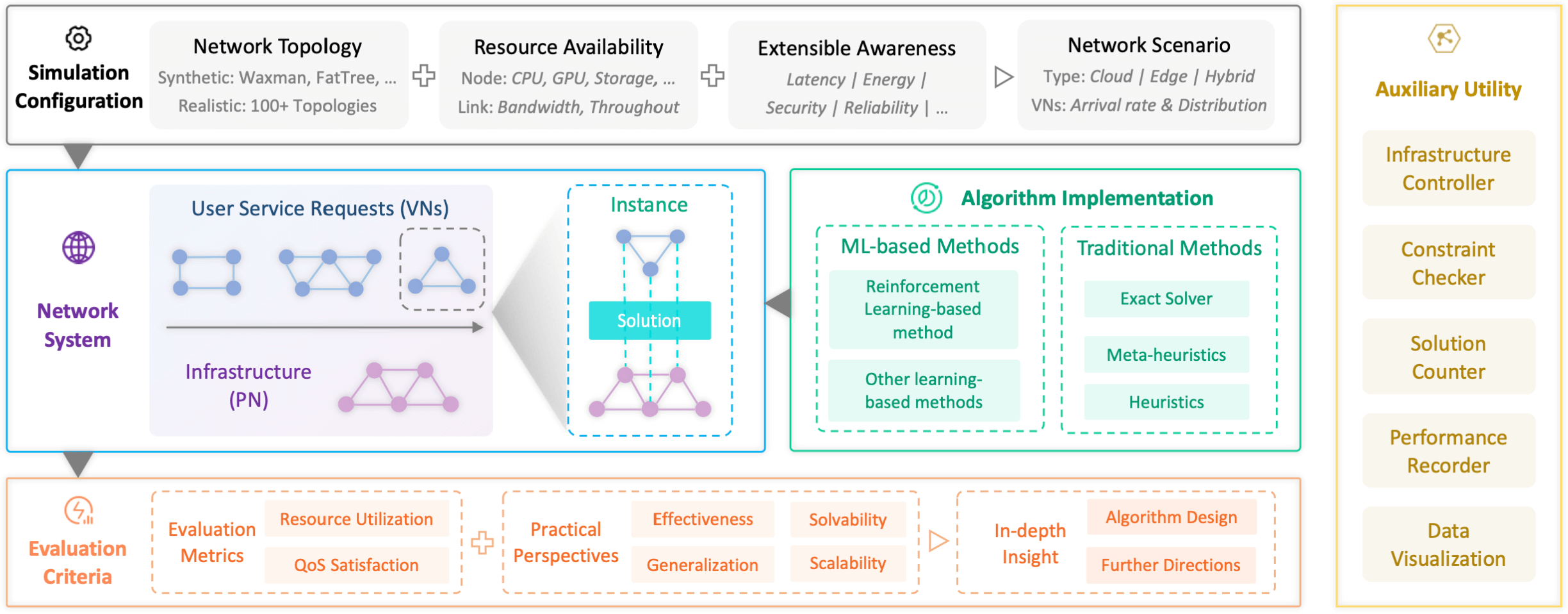
Framework

Virne is designed as a comprehensive and unified benchmarking framework for Network Function Virtualization Resource Allocation (NFV-RA), with a strong emphasis on supporting deep Reinforcement Learning (RL)-based methods. Our goal is to provide an accessible platform for reproducible research and standardized evaluation across diverse network scenarios.

  1. Simulation Configuration

  2. Network System

  3. Algorithm Implementation

  4. Auxiliary Utilities

  5. Evaluation Criteria

Overall Architecture of Virne

Design Principles

The development of Virne is guided by three core design principles, following established software engineering practices:

Versatile Customization

Virne allows for extensive customization to meet diverse simulation needs across various network scenarios and conditions, ensuring high adaptability.

Scalable Modularity

The platform is built with a modular architecture. This design supports flexible configurations and makes Virne easily extensible for new algorithms or network environments.

Intuitive Usability

We prioritize a user-friendly interface and workflow. This enables researchers to focus on experimental outcomes and insights rather than getting bogged down by implementation complexities.

Architecture Overview

The primary modules of Virne are:

Simulation Configuration

This module allows users to define and customize the network environment. Virne can accurately model a wide array of NFV scenarios, from cloud data centers to edge and 5G networks. Key customizable elements include:

  • Network Topologies: Users can select from various synthetic topology generation methods or use real-world physical infrastructure topologies (e.g., from SNDLib).

  • Resource Availability: Define multiple resource types (e.g., CPU, GPU, bandwidth) and their distribution across network nodes, links, and the overall graph.

  • Service Requirements: Specify additional service needs like latency constraints, energy efficiency targets, or reliability metrics.

Network System

Based on the configurations, Virne instantiates an event-driven simulator. This module consists of:

  • Physical Network (PN): The underlying infrastructure.

  • Virtual Network (VN) Requests: A series of sequentially arriving service requests.

Each VN request arrival is treated as a discrete event, creating an instance that the NFV-RA algorithm must solve. The system then evaluates the solution’s feasibility and updates network resources.

Algorithm Implementation

Virne features a modular architecture that simplifies the implementation and integration of diverse NFV-RA algorithms, including exact solvers, heuristics, meta-heuristics, and advanced learning-based methods. For RL-based approaches, Virne provides a unified pipeline (as detailed in Figure 3 of our paper) that standardizes:

  • NFV-RA as a Markov Decision Process (MDP): Modeling the solution construction sequentially.

  • Policy Architectures: Support for various neural network architectures (e.g., MLP, CNN, GCN, GAT).

  • RL Training Methods: Integration of algorithms like PPO, A3C, etc.

  • Gym-style Environments: Facilitating the development and testing of RL agents.

Auxiliary Utilities

To enhance usability and streamline analysis, Virne includes several key utilities:

  • System Controller: Manages the simulation of physical and virtual networks.

  • Solution Monitor: Tracks solution feasibility and performance metrics during execution.

  • Visualization Tools: Provide interactive and visual representations of simulation results for intuitive analysis.

Evaluation Criteria

Virne offers a comprehensive suite of metrics and practical perspectives for systematic evaluation:

  • Standard Performance Metrics: Including Request Acceptance Rate (RAC), Long-term Revenue-to-Cost (LRC), Long-term Average Revenue (LAR), and Average Solving Time (AST).

  • Practicality Perspectives:
    • Solvability: The algorithm’s ability to find feasible solutions.

    • Generalization: Performance reliability across varied network conditions and traffic patterns.

    • Scalability: Effectiveness in handling increases in network size and problem complexity.

Workflow

Virne enables a streamlined workflow for comprehensive experimentation: 1. Customize Simulation: Define network scenarios and conditions via configuration files. 2. Instantiate System: The network system is created, triggering service request events. 3. Algorithm Interaction: At each event, the selected NFV-RA algorithm processes the instance. 4. Record Results: Processing details and final results are automatically recorded for analysis.

This framework is designed to serve as a unified and readily accessible tool for researchers from both the machine learning and networking communities, aiming to accelerate data-centric ML research in network optimization.